
- 作者:侯建建
- 来源:终极一家
- 发布时间:2026-08-26
心理追凶
Chinese firm’s Lixun-1 ‘space tug’ eyes maiden flight in Q1 2027 after key propulsion tests_我的网站

A |
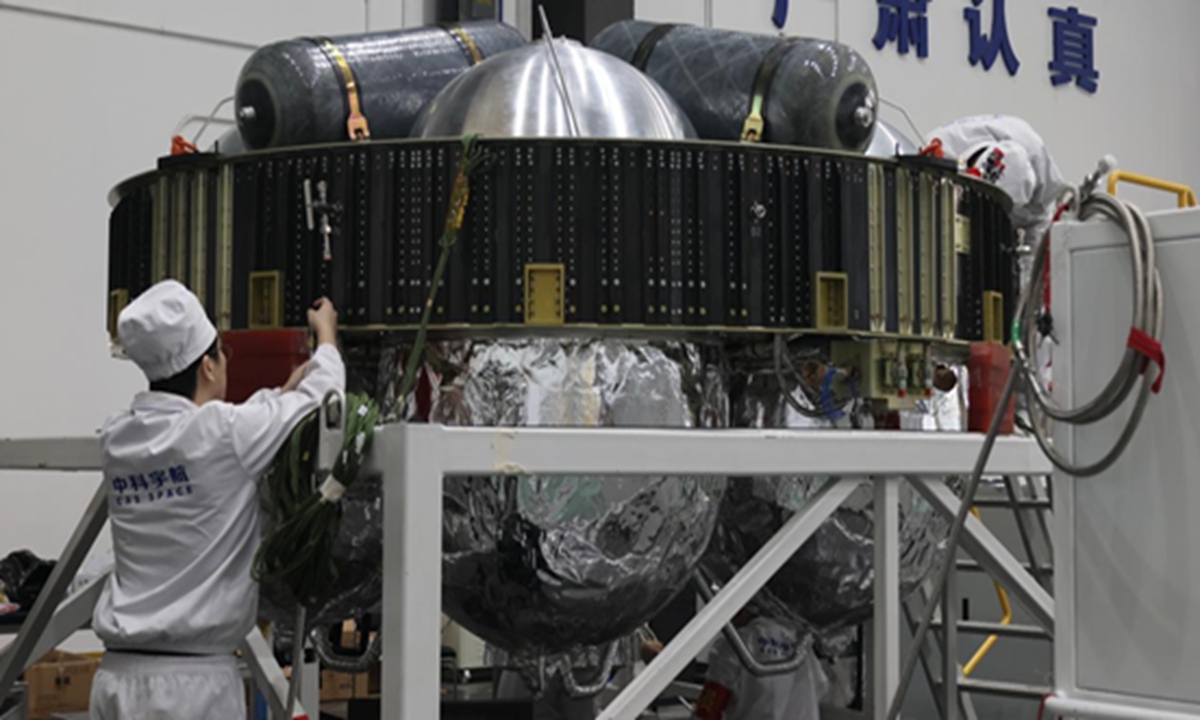
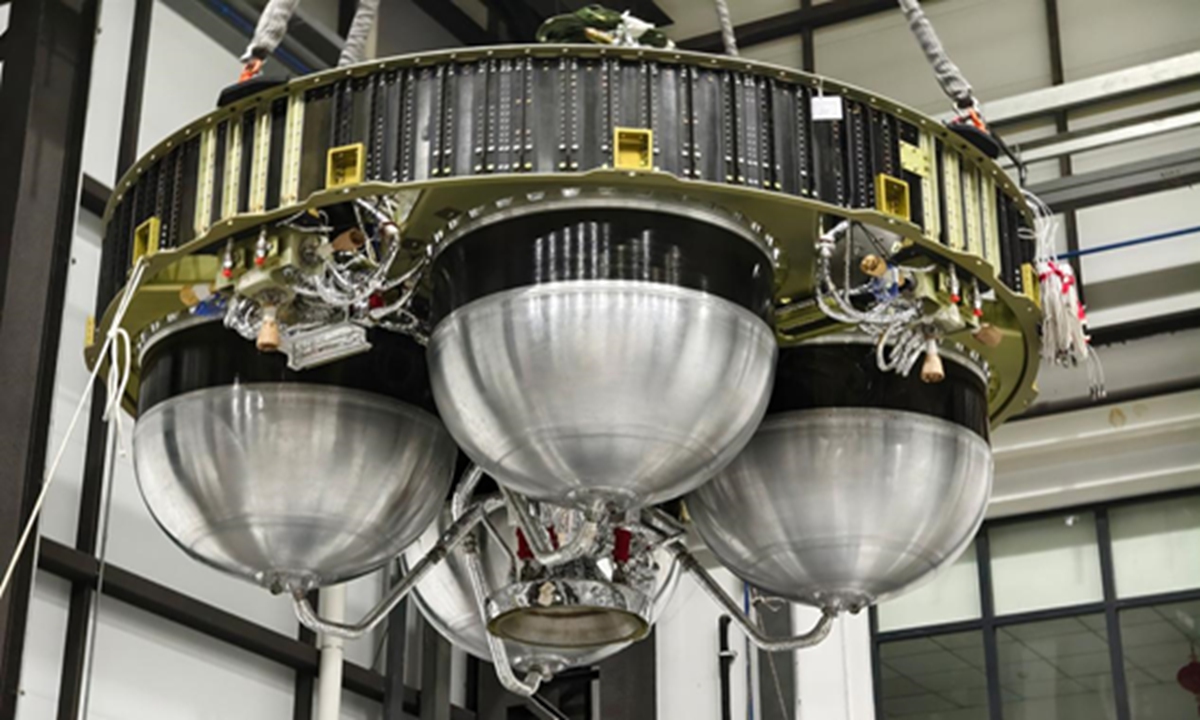
Lixun-1 upper stage, a versatile "space tug" developed by China's commercial space firm CAS Space, is scheduled to make its maiden flight in the first quarter of 2027 after completing a series of key propulsion-system tests, the developer and its chief designer told the Global Times on Tuesday.
The "tug" is designed to ferry satellites from one orbit to another and support missions ranging from constellation deployment to lunar exploration.
While the main stages of a rocket carry payloads from the ground into an initial orbit, an upper stage takes over once the craft is in space. By repeatedly restarting its engine and changing orbit, Lixun-1 can deliver satellites to higher or different orbits, distribute multiple spacecraft to separate destinations during a single launch, or send probes onto trajectories toward the moon and beyond, Global Times learned from the developer.
Yang Haoliang, chief designer of the Lixun-1 upper stage, compared the system to a shuttle service. "If the regular stages of a launch vehicle are like a long-distance bus," - they carry the upper stage and satellites from Earth to a near-Earth parking orbit - the upper stage then takes over as a "space tug," carrying its satellite "passengers" onward to their designated orbital "stops," Yang explained.
That capability can have a direct impact on how efficiently satellites are launched and operated, Yang said. If a satellite has to climb from an initial orbit to its final destination using its own engine, the process can consume a considerable amount of onboard propellant and reduce the fuel available during its operational life. An upper stage can instead perform that orbital transfer, helping conserve satellite fuel and potentially extend its service life.
It can also make one rocket launch do more work. Instead of releasing a batch of satellites into roughly the same orbit, Lixun-1 can repeatedly ignite its engine and maneuver between deployments, sending different satellites to different altitudes and inclinations. Yang said this would help accelerate constellation deployment while improving the efficiency of individual launches.
The practical ambitions behind the system are backed by a major technical milestone reached this month. In August, Lixun-1 completed its PV-001 integrated propulsion-system coordination firing test, during which the entire system operated smoothly for 566 seconds.
Yang told the Global Times that the current Lixun-1 upper stage has a thrust of 20 kilonewtons and can achieve a specific impulse of 315 seconds, which he described as reaching an internationally leading level. The August firing covered the planned profile for the maiden mission, an important step before the system proceeds to flight testing.
The test was more than a demonstration of the engine itself. As an important system-level verification during development, it examined the coordination and engineering reliability of the engine pressurization system, propellant delivery system, propellant management system and servo-control system under the fully integrated configuration.
Of a series of tests that accumulated 5,211 seconds of firing time, the latest one focused on three core technologies: a high-thrust, high-performance 20-kilonewton upper-stage engine capable of multiple starts; balanced propellant delivery from multiple parallel tanks; and a highly reliable integrated electrical system. Their successful verification means Lixun-1 has completed its system-level testing and is ready to move into the flight-test phase, according to the developer.
Lixun-1 has been designed as a modular and generally adaptable upper stage rather than a system tied to only one rocket. It is intended to work with CAS Space's Kinetica-2 and Kinetica-2 heavy-lift variants as well as other launch vehicles, Yang said.
When paired with the Kinetica-2 family, Lixun-1 could significantly expand the rocket's mission range. For communications missions, it could deliver satellites to geosynchronous transfer orbit or even directly to geosynchronous orbit, conserving satellite propellant while supporting the deployment of high-throughput satellites and future 6G communications spacecraft.
For multi-satellite missions, the combination could distribute spacecraft to different orbital altitudes and inclinations during a single launch, potentially serving both low-Earth-orbit constellations and medium- or high-orbit payloads. For deep-space missions, it could place probes onto Earth-moon transfer trajectories and support lunar exploration, Yang said.
The upper stage is designed to be able to conduct more than 20 engine ignitions, autonomously plan orbital-transfer routes and operate under the vacuum and extreme temperature conditions of space. After completing payload deployment, it can also carry out orbital disposal maneuvers to reduce space-debris risks.
Yang said the Lixun-1 and Kinetica-2 combination is designed to cover the vast majority of commercial satellite launch requirements while retaining the ability to participate in major national space projects. More broadly, the upper stage forms part of CAS Space's effort to build launch capabilities reaching medium and high Earth orbits and deep space, extending the reach of China's commercial space sector toward higher orbits and more distant destinations.
。 The Baltic Sea will become an “internal basin” of the NATO bloc after Finland and Sweden join the alliance, with every country bordering the sea barring Russia and its exclave of Kaliningrad to be part of the alliance, Polish President Andrzej Duda has boasted.,“The Baltic sea is essentially poised to become NATO’s internal basin. Two very powerful nations with a long and strong military tradition will become part of NATO soon, extending the Russia-NATO border by 1,400 kilometers, which is no doubt bad news for Russian authorities,” Duda said during a meeting of Poland’s security council on Monday.,Expressing hope that Finland and Sweden are accepted quickly and that their membership is ratified by NATO’s 30 members, Duda stressed that there was “no need for an explanation on how important this decision is for us.”,Late last week, Russian deputy foreign minister Alexander Grushko called the push to incorporate the pair of Nordic countries into the Western alliance “one of the saddest episodes in the evolution” of Europe’s security architecture, and warned that Moscow will be forced to beef up its defenses to compensate for new threats.,“This will severely worsen the military situation in the Baltic Sea region, which, as a result of NATO’s expansion…would be turned into an arena if not of military confrontation, then completely unnecessary military rivalry,” Grushko said.,Russian President Vladimir Putin warned last Wednesday that although Moscow does not have the same type of “problems with Sweden and Finland” as it does with Ukraine, the two countries “should plainly and clearly realize that [while] there were no threats before, now, if military contingents and infrastructure are deployed there, [Russia] will have to respond in a mirror fashion.”,Mayor of Finland's Border Town Mulls Placing NATO Base Directly on Russia's Doorstep3 July, 12:48 GMT,Finland and Sweden completed accession talks at NATO headquarters in Brussels on Monday, with the bloc indicating in a statement that “both countries formally confirmed their willingness and ability to meet the political, legal and military obligations and commitments of NATO membership.” Allies are due to sign accession protocols on Tuesday, after which they will go out to all 30 member countries for ratification.,The pair of Nordic nations broke with generations of neutrality by announcing their bids for NATO membership this spring after Russia began its military operation in Ukraine. Until now, Sweden had maintained strict bloc neutrality since the 19th century, and has not taken part in any large-scale war in Europe since 1814. Finland became neutral at the start of the Cold War, and continued this policy for decades after 1991.,Swedish PM Refuses to Say if Stockholm Will Deport Kurds Wanted in Turkey as Part of NATO DealYesterday, 11:38 GMT,The countries’ neutrality did not prevent them from leaning in NATO’s direction after the collapse of the USSR and the Eastern bloc. They joined the Western alliance’s ‘Partnership for Peace’ program in 1994, and took part in the US-led occupation of Afghanistan, as well as 'peacekeeping' operations in the Serbian breakaway region of Kosovo after 1999. Both countries’ armies, navies and air forces also regularly take part in NATO-led military exercises in the region.,The planned incorporation of Finland and Sweden into NATO is the latest round of the bloc’s eastward push. Since 1990 and Secretary of State James Baker’s famous “not one inch east” promise to Soviet General Secretary Mikhail Gorbachev, the Western bloc has undergone three major waves of eastward expansion, swallowing up the Czech Republic, Hungary and Poland in 1999, Bulgaria, Romania, Slovakia, Slovenia and the Baltic states in 2004, and Albania, Croatia, Montenegro and North Macedonia between 2009 and 2020. After Finland and Sweden’s accession, there will be just nine countries in Europe, Russia included, that are not part of the US-led North Atlantic alliance.,German Lawmaker Reveals How NATO Fooled Gorbachev About Bloc’s Eastward Expansion Plans31 January 2020, 16:43 GMT。
Current article:http://oj6zx.zanjionglangzhaizhizaxiying.buzz/news/20260826_86680.html
Published on:04:01:41
- 本文标签:
- 源代码