小时代
China’s ‘Xuelong 2’ begins first ice station survey in central Arctic Ocean_我的网站

A |
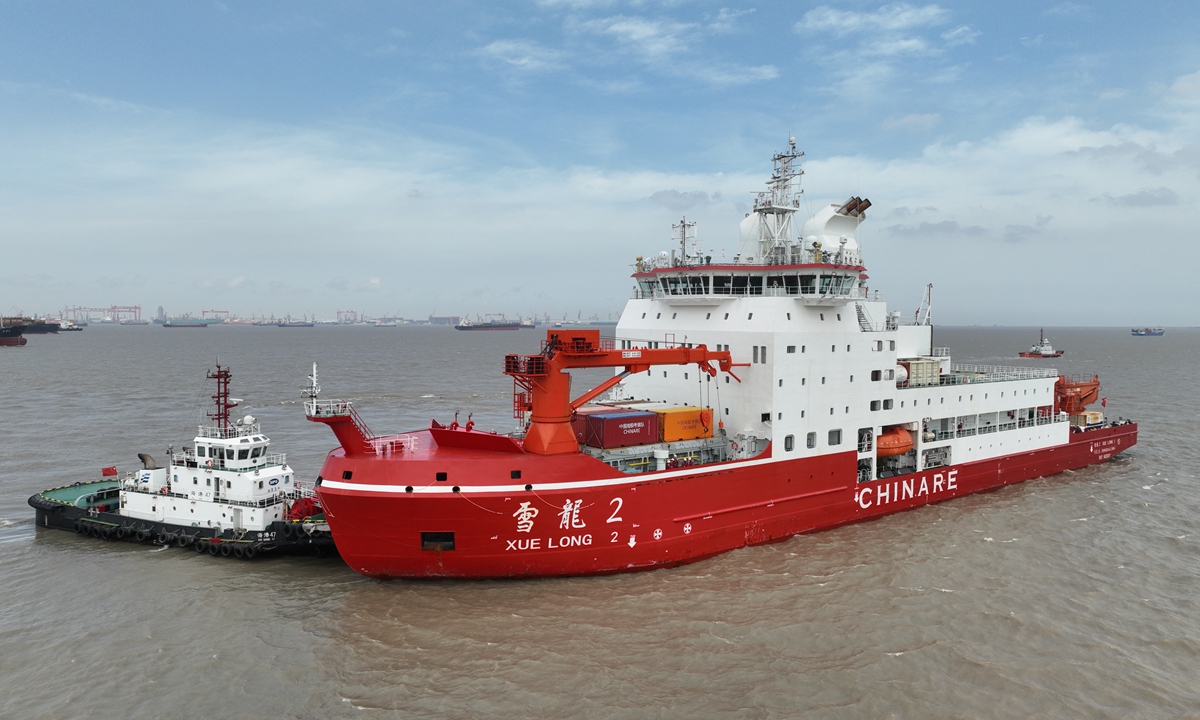
After completing the first stage of comprehensive ocean station surveys on Friday, Xuelong 2 sailed toward higher latitudes and selected a large, relatively flat piece of sea ice about 1.5 meters thick in a densely packed ice zone for its first ice station.
According to Lin Long, captain of the Xuelong 2 sea ice team, the ice station survey conducted by the vessel during this voyage will include six short-term ice stations and one long-term ice station, the Xinhua News Agency reported Sunday.
More than 20 types of scientific operations will be carried out, including the deployment of expendable ice-based buoys, snow and ice-core sampling, under-ice water sampling, sea-ice remote sensing, atmospheric profiling and under-ice oceanographic observations.
Lan Musheng, assistant to the chief scientist of the expedition, said the researchers will comprehensively monitor changes in parameters related to the atmosphere, sea ice, upper ocean and ecological processes beneath the ice as the sea ice melts.
The observations will provide scientific data for studying the rapid changes in Arctic sea ice, the mechanisms behind those changes and the evolution of Arctic ecosystems.
The ice station work is part of China's 16th Arctic Ocean scientific expedition, which was organized by the Ministry of Natural Resources. The expedition set sail from Dalian, Northeast China's Liaoning Province on July 3.
The mission is being carried out by four vessels - Xuelong, Xuelong 2, Jidi and Tansuo-3 - and is expected to be completed in early October.
The expedition is focusing on comprehensive surveys of sea ice, hydrology, biology, ecology and the atmospheric environment in key areas of the Arctic Ocean.
The two icebreakers Xuelong and Xuelong 2 will work together on the ice station surveys. Xuelong completed surveys at 12 ice stations on Friday.
Lin said the ice station locations planned for Xuelong 2 will work in coordination with those of Xuelong to form an observation array.
The arrangement will allow researchers to more deeply investigate the interactions among the atmosphere, sea ice and ocean in the central Arctic Ocean amid rapid environmental changes, as well as their coupling effects with the ecosystem.
The expedition is being conducted against a backdrop of rapid changes in the Arctic environment.
When the mission was launched in July, expedition leader Wang Jinhui said that global warming was driving rapid and profound changes in the Arctic natural environment, with trends such as sea-ice melting intensifying.
The expedition is therefore designed not only to monitor environmental changes but also to investigate frontier scientific questions, including the dynamic evolution of the oceanic crust.
Working on sea ice also presents significant safety challenges. Low temperatures and complex ice-surface conditions can pose risks to researchers, while polar bears are considered the biggest safety risk during ice station operations.
The expedition team has therefore formulated specific bear-prevention and emergency response plans and equipped personnel with various types of bear-deterrence equipment and emergency supplies to ensure their safety.
。 讯 8月20日,交通运输部举行专题新闻发布会,介绍“人工智能+交通运输”典型应用场景创新行动有关情况。 会上,交通运输部科技司司长徐文强表示,近年来,交通运输部加快推进人工智能与交通运输深度融合,聚焦基础设施、运载工具与装备、运输服务、行业治理4大方向,梳理形成覆盖铁、公、水、航、邮全领域860项率先突破场景。

B | 去年9月,交通运输部联合6部门,出台了《关于“人工智能+交通运输”的实施意见》,全面绘制了“人工智能+交通运输”的方向标和路线图。

C | 今年6月,交通运输部又会同国家铁路局、中国民航局、国家邮政局和国家铁路集团,印发了《“人工智能+交通运输”典型应用场景创新行动方案》,全面启动了典型应用场景创新行动,打通政策落地“最后一公里”,推动人工智能技术更加有力驱动加快建设交通强国。

D | 本次创新行动将场景任务分为应用推广、创新示范、攻关突破三类,牵头主体分为场景方牵头和技术企业牵头两种模式。划分“三类场景”、采用“两种牵头模式”,开展典型应用场景创新行动,就是要密切跟踪、及时总结交通运输行业技术创新的全链条规律,区分不同技术成熟度、不同业务属性的场景,让场景所有方、科技企业、科研院所都能找到定位、发挥所长,避免“一套标准管到底”,最大化激发各方创新活力。

E | 具体来看,三类场景分别对应了技术落地的三个阶段,牵头主体的设置也充分匹配各阶段的核心需求。 应用推广类,主要面向技术已经成熟、商业模式清晰、行业有普遍需求的场景,比如高速公路智能监测、12328智能客服、场站智能安检,就属于这一类。这类场景的核心目标是“规模应用”,让好技术尽快从“点上示范”走向“面上普及”。

F | 因此,明确由“场景所有方”牵头,因为他们掌握路网、港口、场站这些实体资源,有成熟的运营运维体系,能最快推动规模化落地,形成可复制、可推广的行业通用解决方案。 创新示范类,重点是推进成熟技术的系统集成和跨领域融合,比如多式联运智能调度、综合枢纽一站式智慧服务。

G | 这类项目不缺单项技术,难点在于如何打通不同部门、不同运输方式的业务流程和数据壁垒。

H | 所以也明确由“场景所有方”牵头,统筹业务资源,联合人工智能企业、科研院所,做集成创新,核心是“提质融合”,打造一批高水平的融合应用标杆。 攻关突破类,瞄准的是行业核心技术短板,比如交通专用垂直大模型、路侧轻量化智能终端、复杂场景自主决策算法。这些是行业的“卡脖子”环节,需要很强的算法研发和算力支撑。因此这一类由“人工智能科技企业”牵头,行业用户作为参与方,提供真实测试场景和业务验证,核心是“强基础补短板”,用真实场景打磨形成核心技术能力。

I | 版权申明:凡注有“”或电头为“”的稿件,均为独家版权所有,未经许可不得转载或镜像;授权转载必须注明来源为“”,并保留“”的电头。 。

J |
Current article:http://oj6zx.zanjionglangzhaizhizaxiying.buzz/stsbmj/20260826/4866199.html
Published on:13:19:40


